Gratin d’Endives au Jambon

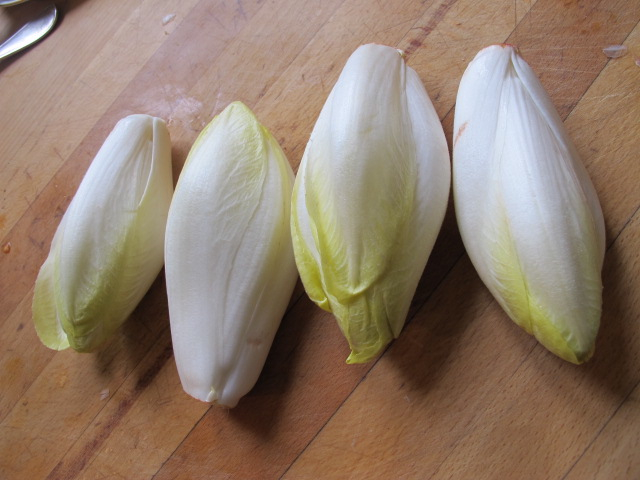
Endives
Witlof, Chicory, Endive… also known as the ‘Pearl of the North’ in France

‘Witlof’, ‘Chicory’, ‘Chicon’, ‘Endive’, ‘Belgian Endive’… I’m never quite sure what to call this vegetable.  Each country seems to have a different name for it.  In Australia for example, we call it ‘witlof’?  Here in France it is called ‘endive’ and would you believe it has been grown commercially since only the 1930’s.

Whatever the name for it, since moving to France I have developed a huge liking for this interesting vegetable from the Chicory family.  Thanks to Benji and his mum, I was introduced to a beautiful new ingredient and a few recipes that are now  family favourites. Even our six-year-old loves eating them.

Endives are so verstile – they make a great salad when served raw with vinaigrette drizzled over it or, the particular family favourite, when braised with white wine and lardons and parsley, over a gentle heat for a few hours (the longer the better, you want them to caramelise!).  You can serve this dish on its own or it makes a great side dish to lamb chops, veal or pork.

During the first few weeks of us living back in Australia in 2004, I decided to prepare the family favourite for our  friends who we were lodging with.  I was so excited to share this newly-loved vegetable of mine.  After quite a search, I finally found them in a fruit and veg shop in North Fitzroy.  I filled the bag, enough for four people and when I went to pay I nearly fell over.  They were so expensive!  I concealed my shock and quietly paid the money, vowing never again to buy this vegie in this suburb again.  I at last appreciated why Claude (my Frenchie – amazing cook – friend who was living in Western Australia with his NZ wife), when he had yearnings for a good old endive dish, would only use three or four of them in a gratin.  Braising them en masse was a complete luxury.  Anyway – big sigh of relief – the dish worked out pretty well that evening, but not to be repeated for quite some time!

Here in France however, they are cheap and we eat them regularly, especially around October.  A few years ago, I had to prepare a lunch at the last minute for some friends of friends travelling through the area.  I added pan-fried chicken thigh fillets and julienned carrots to a pot of left-over braised endives and the result was really delicious.   One of our lunch guests, the owner of a well-known bakery in Melbourne (yeah, not much pressure), was keen to get the recipe.   High five!  I was tres contente.  I’ve been adding the chicken and the carrots for many a meal since.

But much to my husband’s relief (I’m someone that could eat the same dish 4 times in the one week if I like it), I’ve branched out and tried a new recipe  – the traditional ‘Gratin d’Endives au Jambon’ (Endives and Ham Gratin).  Once again, as is usual for all the recipes I prepare, this is pretty simple and easy to make.  It is a particularly good dish for the Autumn-Winter months and with today’s maximum temperature reaching six degrees celsius, I think I should get to it and make some.

Here’s the recipe for you…  (I should tell Claude I’ve finally made it)

Gratin d’Endives au Jambon (serves 6)
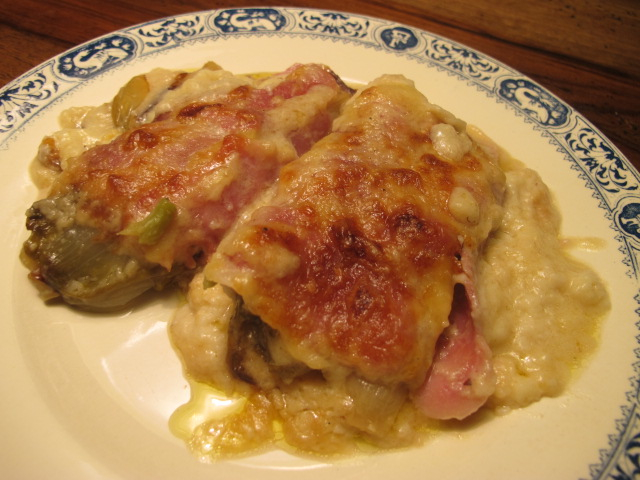
Gratin d'Endives
Gratin d’Endives

ingredients:

(note:  my quantities are always on the generous side – I prefer to have left-overs than not enough!)

8-10 endives (depending on size)

8 slices ham

60g butter

60g plain flour

200g Swiss Gruyere, grated (the AOC Gruyere ‘Alpage’ or ‘Reserve’ are incredible! – and even available in Australia)

1 litre full cream milk

salt, pepper

olive oil

method:

Trim stems off endives, pull off any discoloured leaves, then cut in half (I do this to help with cooking them through and browning)

Fry the endives in a pan over a low-medium heat with a little olive oil.  As they begin to brown (or burn!), you can pour in a small amount of white wine to keep the pan moist.  Fry until golden/dark golden and moisture has evaporated

(NB: some like to steam or boil the endives to part cook them but I prefer to fry them as I find there is too much liquid in the baking dish later when serving)

+ Heat oven to 180 degrees Celsius (about 7 or 8 on my gas oven) +

endive 1
Fry the endives until golden

While the endives are cooking, prepare the cheese sauce (I like to grate the cheese before beginning the sauce so that your hands are free to keep stirring – and ready to be added when needed)

endives 2
While the endives are cooking, prepare the cheese sauce

Melt butter in large saucepan

Heat milk in a different saucepan (it helps reduce overall cooking time if the milk is warm)

Stir in flour with a wooden spoon and cook for a few minutes over a gentle heat, stirring continuously.

Once it becomes a golden paste, pour in heated milk gradually, stirring continuously

(NB: How much milk you add depends on how thick or thin you like your sauce – my husband likes it thin and runny but I like it thickish and runny – so you may want to use less or more than the 1 litre.  Just remember it will thicken over the heat eventually!)

add salt, pepper to taste

Once it comes to the boil, add the cheese and stir until melted.

Remove from heat.

Oil a large gratin/ baking dish

Gather your endive halves, wrapping two halves inside each slice of ham (as though it’s a whole endive)

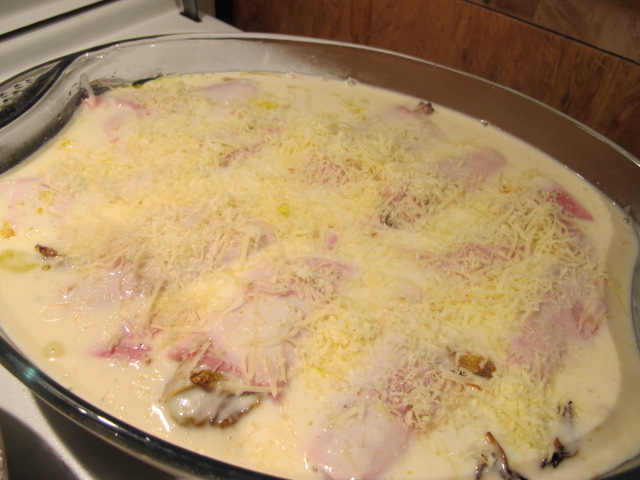
Place them in the baking dish and pour cheese sauce over the top – add a little extra grated Gruyere if desired
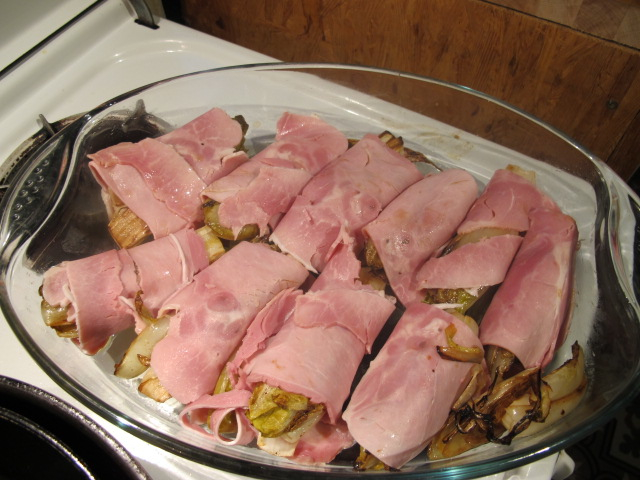
endives 3
Place the wrapped endives in an oiled gratin/baking dish.
(there’s 10 and not 8 in this one)
endive 4
Pour the cheese sauce over the endives and sprinkle with grated Gruyere

Bake for about 30 minutes or until golden

et Voila!
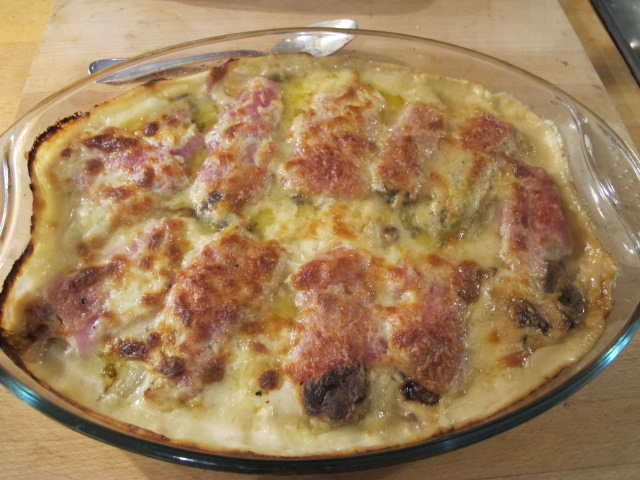
endive 6
Ready to serve

Simple Country Lentils*

(* this dish is a version of the one listed in the fabulous “French Farmhouse Cookbook” by Susan Herrmann Loomis)

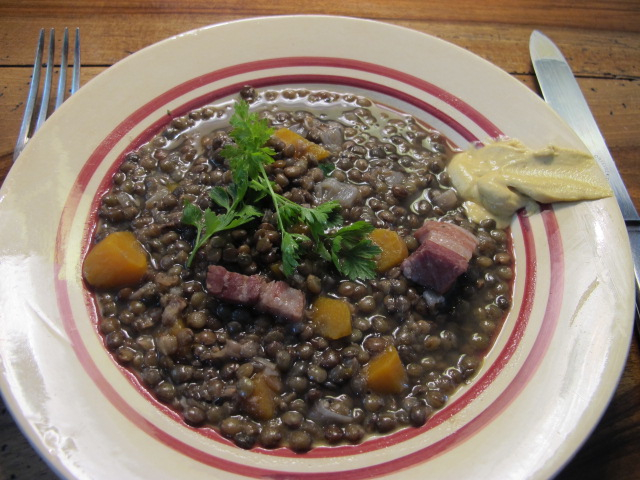
a simple lentil dish
a very simple lentil dish – minus the sausages

Nothing like keeping the monsieur happy – and at this time more than any other. Harvest time means good, honest, country cooking and this very simple (the best kind!) lentil dish is a winner in our house.  It’s easy and so versatile – it’s great on its own or delicious paired with country sausages, pork chops, lamb chops, whatever you feel like.  They say that dried pulses were a staple in many homes during the harsh Winter months, a time when people also consumed more preserved, salted meats (no wonder I feel like large slabs of juicy ‘petit sale’ with my lentils).

porc demi-sel
pork for your fork
(‘petit sale’ or ‘porc demi-sel’)

And it’s another one of those dishes that tastes better and better each day it gets older!

I first tried this dish here in France at Benji’s parents’ house.  A large cast-iron pot was plonked in the middle of the table and we helped ourselves to this comfort-food’ – the country sausages (mmn, like a bit of country saucisse, but not these!!) swimming in a dark brown-green mass of  steaming lentils, with dollops of Dijon mustard, soaking it all up with crusty bread and wine.

I’m wondering if it was the first time I’d had ‘Puy’ lentils?  These are a dark green/grey coloured lentil commonly found in ‘Le Puy’, in the Auvergne area of France.  Grown in volcanic soil, they are very small and lovely to cook with as they retain their form.  Until that time, all the lentil dishes I’d tried were mostly Indian influenced, eg dhal, using red or brown lentils.  Come to think of it, I used to eat a lot more ‘Asian’-influenced dishes in Australia.  Coriander, soy sauce, chillies and limes were far more common sights in the kitchen than wild thyme, bay leaves and olive oil.  Who would have thought…

Simple Country Lentils

ingredients:

500g green Puy lentils (this will serve about 6 people)

2 onions, diced

4 carrots, chopped

250g salted pork, cut into chunks (optional)

3 cloves garlic, finely chopped

1 sprig fresh thyme

bay leaf

country sausages/ frankfurters (1-2 per person) – (optional)

parsley  and mustard for serving

pepper to taste (if you are using the salted pork you will not need to add any salt)

method:

Fry your onion until golden in a generous amount of olive oil, in a heavy casserole pot

+ During this time, boil a full kettle of water for pouring over the lentils later – the hot water greatly reduces the cooking time +

Add the roughly cut chunks of salted pork and fry for a few minutes, stirring frequently

Add the carrots and the garlic, give a good stir

Now add the lentils, stir well

lentils 1
add the lentils and stir

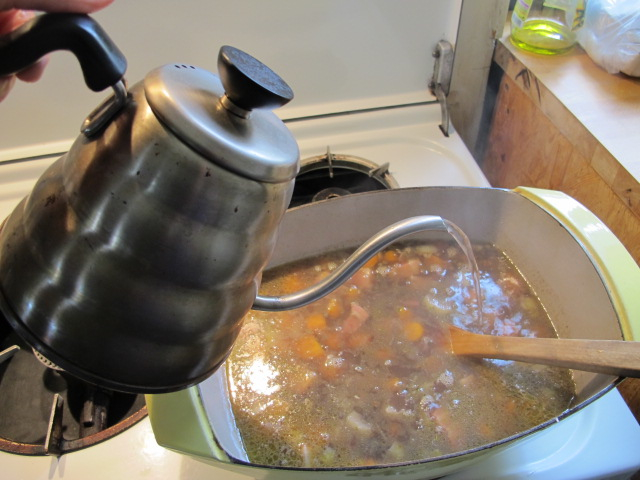
Pour boiling water to cover well.

N.B. During the cooking, you will find that the lentils soak up a lot of water, you may need to add a second pot of boiling water over the mixture if you have no liquid left.  I know, it may look like you are drowning the lentils with water, but believe me it does dry up!

lentils 2
pour boiling water over the lentils etc and then cover

Add herbs and pepper to taste.  

N.B. You do not need to add salt if using the salted pork (I’ve made that mistake!) – but if you’re not using meat DO NOT salt at this point.  – adding salt to lentils during cooking may toughen them up.  Add it after the cooking.

Cover with lid and let simmer for one hour (if you have too much liquid, leave the lid slightly ajar) – or until lentils are tender.

Voila! – and enjoy with a light red or a dry white…

Philippa’s Oven-Baked Asparagus

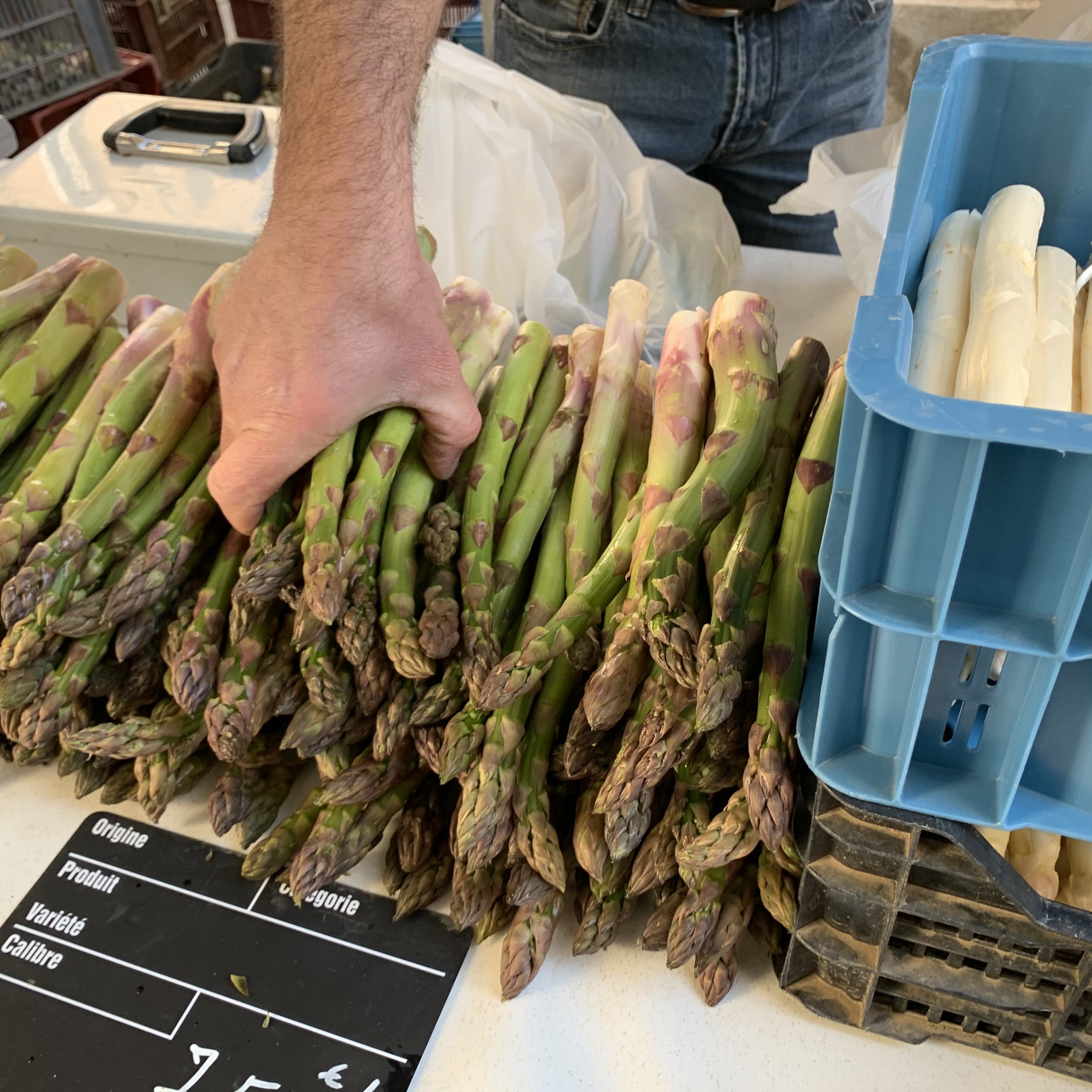
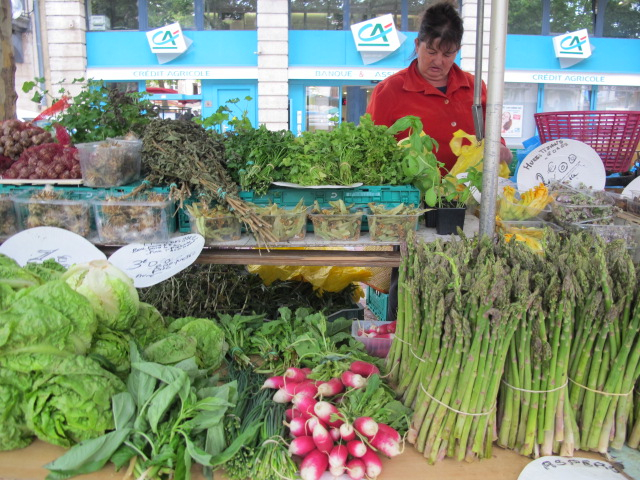
I want to share a little recipe with you.  It’s asparagus season here and every year we eat tonnes of it and the way we’ve normally prepared it, is steamed until al dente and served on a platter with boiled egg scattered over the top and then washed over with a mustard vinaigrette (essentially an oil-based sauce with vinegar – to which you can add lemon juice, salt, pepper, mustard etc,  whatever you feel like!).

market asparagus


another asparagus grower at the Olonzac market
…more asparagus at the Olonzac market
asparagus carcassonne market
asparagus at the Carcassonne market

We’ve been eating it for years and I’ve never considered preparing it any other way, I like it so much!  That is, until I ate Philippa’s oven-baked asparagus.

Philippa and her partner John have a winery here in the Minervois – Hegarty Chamans – where they make a great range of organic and biodynamic whites (I love their Marsanne Roussanne!) and reds.  Their philosophy of how they make their wines follows into the kitchen.  Philippa is an amazing cook and meals there are a real treat.  It’s like a celebration of fresh produce (often from their ‘potager’/ vegie patch), colours and aromas.   There’s no messing around, just simple, pure flavours blended beautifully together.  And it all feels so healthy! (if I leave my wine consumption out of the equation).    This dish in particular is a beauty.  Thanks Philippa, I’ve been hooked ever since you served this entree of asparagus!


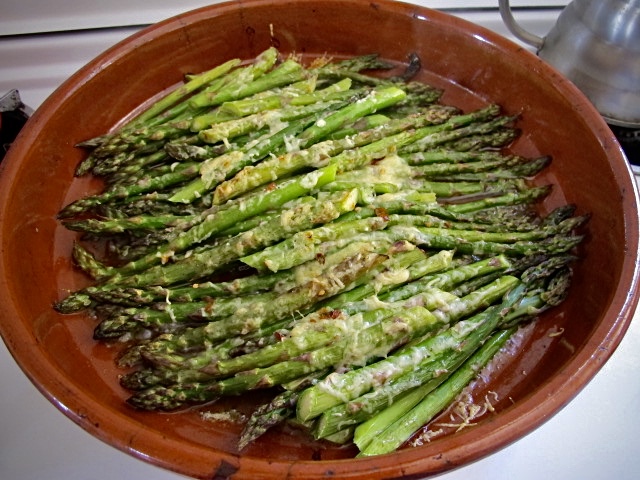
asparagus-post-cooking1

Philippa’s Oven-Baked Asparagus

(Yum!  and great served as an entree…)

ingredients:

2-3 bunches green asparagus

olive oil

a good cup full of grated Swiss Gruyere (my favourite cheese EVER) or Parmesan

3-4 dried chopped dried chillies (or 1 or 2 fresh – very hard to find around these parts!)

salt and pepper

method:

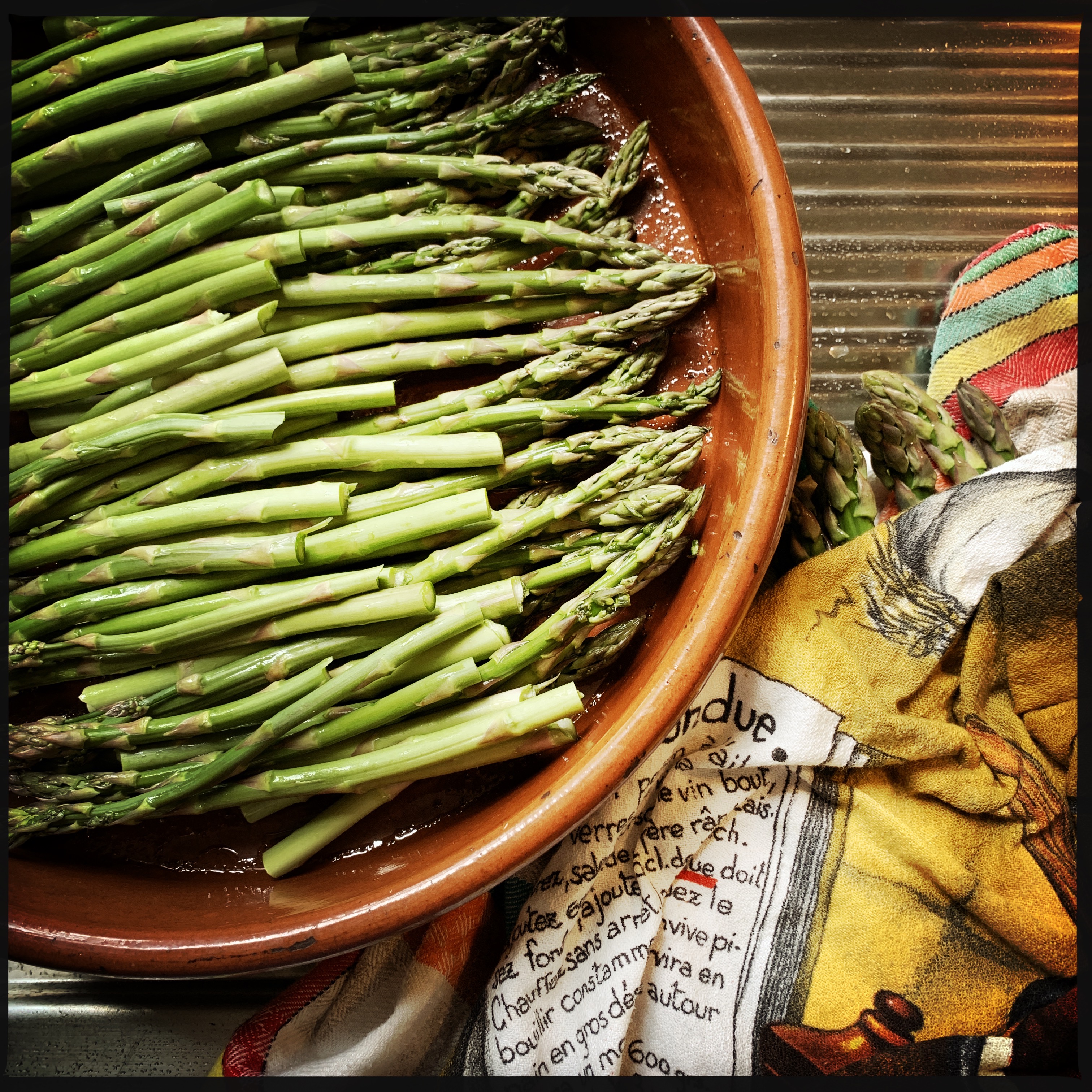
chop the ends off the asparagus spears (I never really peel the ends), then rinse and pat dry in a teatowel

pour olive oil into bottom of a good heavy baking dish and swirl to spead the oil

place the spears, then top with the cheese, then the chillies, drizzle more oil and then add salt, pepper to taste

bake in moderate to hot oven (in my old gas oven I cook them on ‘7’) for 30 mins ( or for however long you want, depending on how much crunch you want to leave in the spears)

Et voila!  so simple and so delicious!

Kat xoxo

…and a note on the wine!  Asparagus is a difficult thing to match with wine.  But if you really can’t resist, go ahead and eat them with a dry but fruity white… Sauvignon Blanc, Pinot Gris

It’s time for Ratatouille! …have I got the spelling right??

…Umm, here we go again!  For those of you who saw this as a ‘mini-post’ a few hours ago, you must have been thinking ‘so where the heck is that recipe then?’.   Well, I was in a hurry to pick up our child from school and WHOOPS pressed the ‘publish’ button instead of ‘save draft’.   I’ll give it another try.

As for the spelling  …well yes, I checked in the cookbook.  It’s one of those words, like ‘rhythm’ or ‘Mediterranean’… I always have to think twice about it or look it up!

So here is my version of a ‘Rattatooey’ (that’s how I pronounce it, causing grimaces all round I’m sure) – a very traditional French dish that for me, unlike any other dish, evokes Summer in the South.  The colours of the ingredients are sublime and just thinking about cooking it conjures up images of potagers (vegetable patches), big cast-iron casserole pots simmering on country kitchen stoves, lashings of fresh basil and chilled French wines.  Many households are cooking up this dish right now and on my visits to friends’ houses I love nothing more than peeking into their pots to see what theirs look like.  Vegies cut big or small? Diced or sliced??  Oily, not so oily?  Fresh tomotoes, tinned?

I say ‘my’ version as yes, there are many.  The ingredients are almost always the same, but the cooking methods differ.  I’m a little embarrassed admitting that mine has conserved tomatoes in it instead of fresh, but it has.  A good friend of ours came to stay this Summer (more of him in later posts) and being the most wonderful cook he is (and being French, I must also add) I was eager to get his opinion on what the ‘correct’ way to prepare this is.  Strike out!  He insisted the tomatoes had to be fresh.  Ohh, I thought to myself, now I feel unworthy.  Oh well.  It’s always tasted good to us and what’s the point in arguing with this Frenchman, whose opinions on cooking and wine I admire so much.

I should add that my two of my  favourite references for cooking are Stephanie Alexander’s ‘The Cook’s Companion’ and Susan Herrmann Loomis’s ‘French Farmhouse Cookbook’ and I first accessed this recipe from their reassuring pages.   They were both wedding presents and how many times did I think to myself in those early days as a mute-non-speaking the local language-housewife with her apron – ‘where wold I be with out you??!??’   Well I must say that neither of their versions use conserve/ tinned tomatoes either!

Our friend did have a little extra advice for me too.  On his departure, he mentioned that during the vintage I should be preparing many good meals for my husband, be kind and – with a wink –  be a ‘bonne femme’.  What did he mean?  Did he really mean the housewife variety relegated to her stove or being simply good to Him?  In the kitchen, elsewhere? (now don’t go there…).  Mais merci, I’ll take that on board.

Incidentally, in  French, ‘bonne femme’ could be either ‘good woman’ or ‘good wife’ – it’s the same term for both.  For the blokes however, there’s no such confusion as husband has its own word – ‘mari’.

I’m beginning to think we’re all destined to be good housewives here! (in the countryside anyway, if not the towns).

Anyway, here’s my recipe, minus the fresh tomatoes, from one Bonne Femme to you!

‘Ratatouille’

With these quantities, you can serve this to 6-8 people and still have left-overs.

This is one of those dishes that just gets better and better on the second and third days.  Ideally, I make this the night before serving.

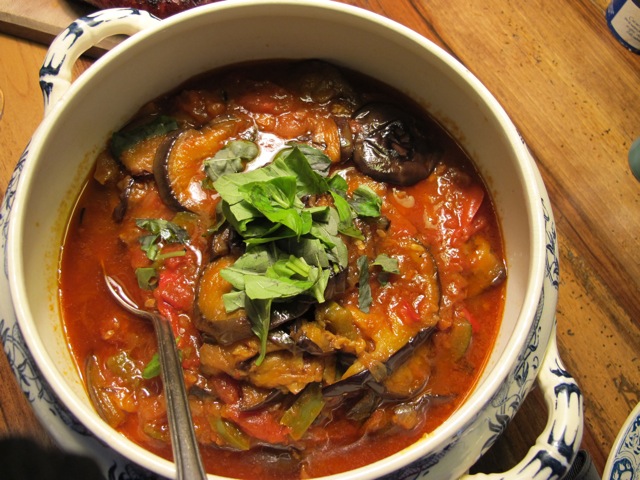
ratatouille
ratatouille

Ingredients:

(I change my portions each time, according to how it looks in the pot, so these quantities can be varied according to your taste)

4-5 medium onions, sliced (I love them!)

5 cloves garlic, finely chopped

4 eggplants, sliced

8 zucchinis, sliced to 1cm thickness

3-4 capsicums (that is, peppers or poivrons, depending on your country!) – green, yellow and red, seeded and sliced

1 x 690g bottle crushed tomato pulp (you may not want to pour all of it in)

2 x 800g tin tomatoes

salt, pepper

olive oil, sunflower oil for frying

chopped parsley and torn basil

method:

Cut the eggplant into 1cm (or finer if you like) slices, place the slices in layers on a large tray, sprinkling salt over each layer.  Cover with tin foil, weigh down with a heavy book and leave for one hour.

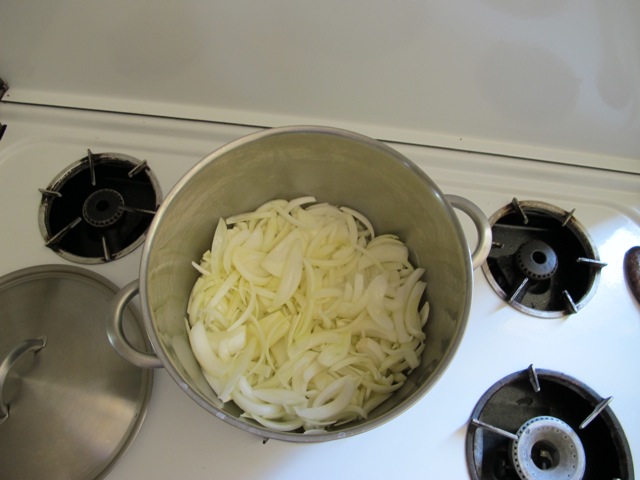
Heat up a generous amount of oil in a large cast-iron casserole/ heavy-bottomed pot and fry the onions over medium-low heat until soft and golden.

a lotta onions
I love onions

While the onions are frying,  seed and chop capsicums, chop zucchinis, chop garlic.

'tricolore' de poivrons
a ‘tricolore’ of capsicums

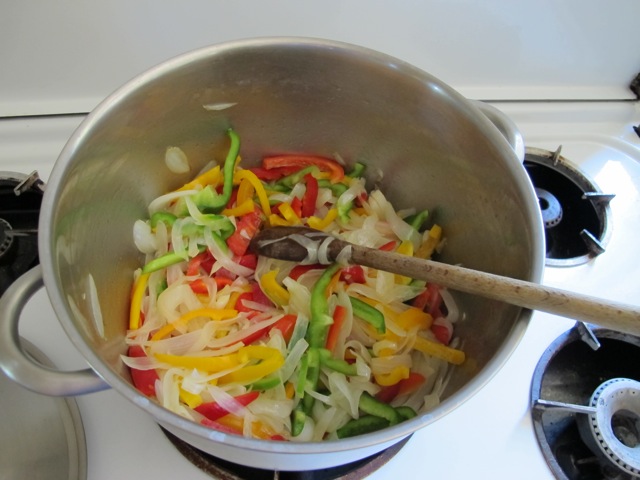
As the onions become soft and golden, add the capsicum and the garlic and stir well.  Increase heat to medium-high, stirring frequently to mix the ingredients.

Lower heat, cover with lid.  Cook for further 15 minutes.

onions and capsicums

During this time, rinse the eggplant slices, drain through a colander and pat dry with tea towels.

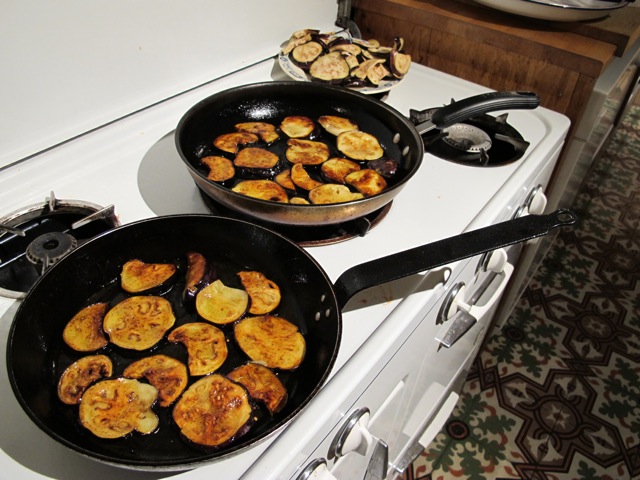
Prepare one or two fry pans for  shallow frying eggplants with generous amount of blended olive oil/ sunflower oil in each.

Stir in the tomatoes into the pot.

tomatoes added

Stir in zucchinis to the pot, add freshly ground pepper and continue simmering with lid on.

Over a high heat (watch that the oil doesn’t burn) fry the eggplant slices until golden, re-adding oils to the pan/s regularly.  This step is one of the most time-consuming in this recipe, but I really think it makes a difference to the dish. Once slices are cooked, I lay them aside on paper towels on a large tray.

Please note: I don’t salt the pot until I’ve tasted it with the eggplant added – even if the eggplants have been well-rinsed there can be a residue of salt.

frying the eggplant
Using two fry pans can reduce the time spent over the stove!

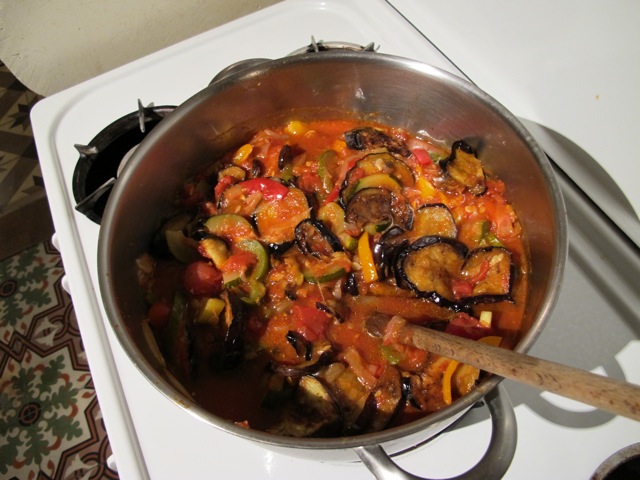
Once all the eggplant slices have been fried, I add them to the pot, taste for salt and then re-cover and leave simmering for another 20 minutes.

almost there with the ratatouille

Serve cold, warm or hot the next day with torn basil leaves and freshly chopped parsley.

This is a great side dish for bbq’d meats – especially lamb.  It also goes very well with country sausages.

barbecued country sausage

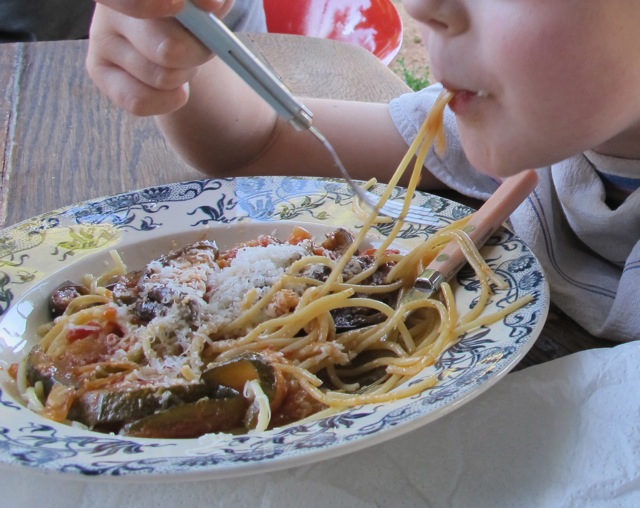
We also enjoy serving left-over ratatouille as a pizza base or tossed through pasta – it’s a delicious mix with spaghetti or fettuccine, sprinkled with basil and parmesan. 

It’s a great way to get Lilas to eat her vegies!

ratatouille spaghetti

a very simple cauliflower dish

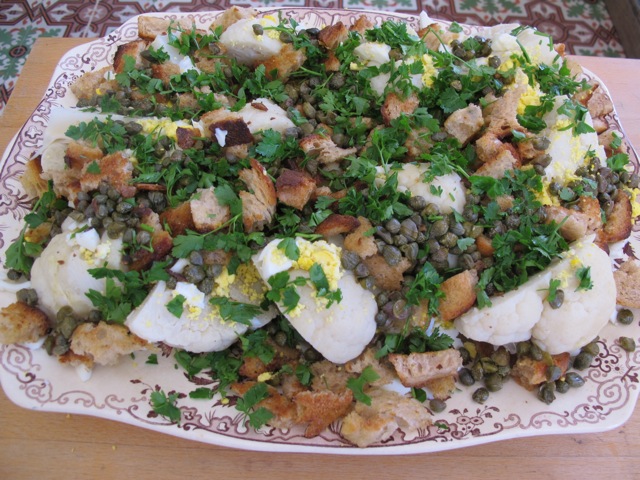
Cauliflower Polonaise
a very big version of the ‘Cauliflower Polonaise’

This has to be one of our all-time favourites and is so ridiculously easy to make!   The combination of flavours with the simple cauliflower base is completely moreish (especially if you’re a salt lover like me).

It wasn’t until I moved to France that I started eating so much of this vegetable.  At home my parents didn’t really serve it – note: we DID actually eat vegetables at my parents’, and not just the frozen variety either, just in case you were thinking ‘ahh, those Aussies with their chops and three frozen veg’…  But I remember it well at one of my best-friend’s mum’s…  She would always serve ‘cauliflower cheese’ with a family roast and we’d all fight over it.  But these were probably the only times I ate it. In France my husband’s family eat it regularly and eat it as an entree or sidedish, boiled or steamed and then served with a vinaigrette poured over the top and chopped parsley.  This recipe isn’t very different to this, just a few more flavours and time in preparing each ingredient.  It comes from one of the queens of cooking in Australia, Stephanie Alexander, in her brilliant ‘The Cook’s Companion’.  When Benjamin and I first moved to France this was one of the only two cookbooks we brought with us on the plane (and you should see how big the book is), and I can’t believe how helpful it’s been, all this time.

We eat this as an entree, or to accompany a BBQ.   And it is amazing as left-overs the next day or two (if you’re anything like me and love to eat food upto a week after it’s been in the fridge.  Parents from the Depression and their influence!!..)

‘Cauliflower Polonaise’ (from Stephanie Alexander) – serves 4 with these quantities, but I tend to always double it!

ingredients:

1-2 cauliflower

2 hardboiled eggs (no time for arguments!)

2 tablespoons fresh breadcrumbs

40g butter

oil or butter for frying the capers

1 tablespoon freshly chopped parsley

salt

freshly ground black pepper

Oh, and I almost forgot: a small cup of home-made vinaigrette (I have added this to the recipe as I like it moist!)mustard, lemon juice, salt, pepper, red-wine vinegar, olive oil

method:

Steam cauliflower, section it up  and then put aside on a serving dish.  (You may like to prepare all the ingredients ahead, so that the dish is served hot or warm, or otherwise serve at room temperature).

Shell the eggs, and separate the yolks from the whites (my husband thinks I’m nuts every time I insist on doing this).  Chop up the whites and then crush the yolks with the back of a fork, keep apart in bowls for later.

In a frying pan, toss the breadcrumbs in the butter, always tossing to avoid them burning.  I like my mix to have larger crouton-sized chinks as well as crumbs, so maybe do the chunks forst and then add the crumbs at the end.  Fry until very golden.

Drain and then fry the capers in some oil or butter until they open.

Scatter ingredients over the cauliflower in this order – egg whites, yolk, breadcrumbs/ croutons, capers and then the parsley.  Pour over with vinaigrette… et voila!