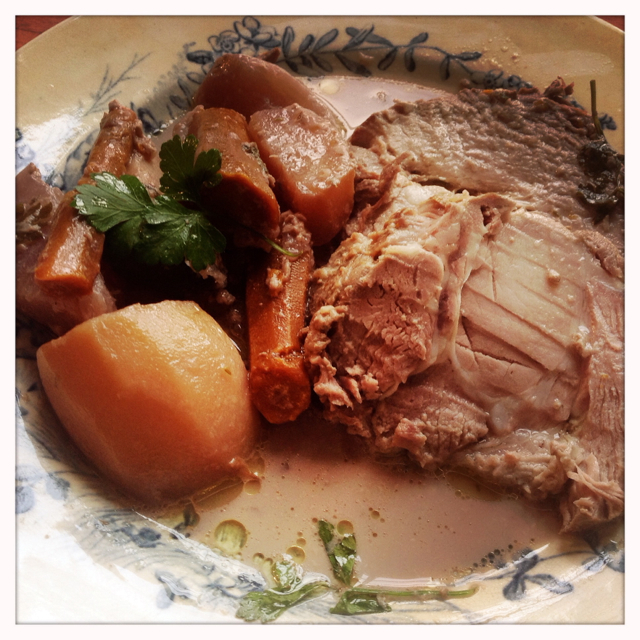
I was on the phone to Mum and Dad last week and mentioned that I’d just cooked up some Milk Pork – ‘Porc au Lait’ – for the next day’s dinner. It’s funny, these conversations about food are always totally out of whack with our time zones. It was 11pm my time and 8.30am the following morning, their time. Normally it’s me cleaning up the breakfast dishes as Dad explains with excitement what he’s got on the stove for dinner.
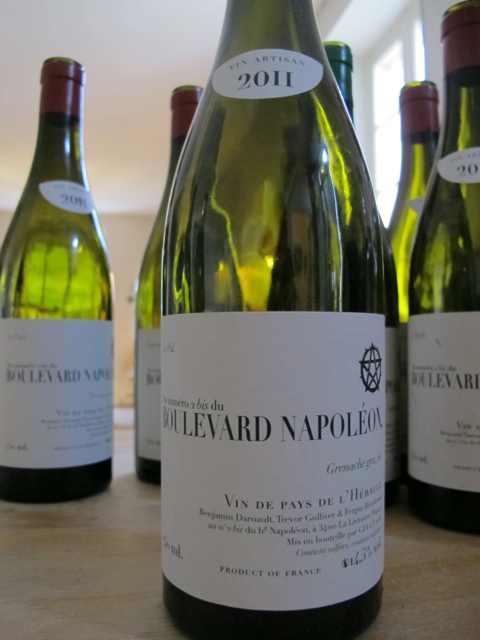
I’ve never served them Porc au Lait but I know they’d love it. It ticks all our family’s favourite food boxes: MEAT, lots of sauce, herbs, garlic and the required ‘three veg’ – and it is easy to prepare. It’s one of those old-fashioned French dishes that is simply delicious comfort food. My husband and mother-in-law showed me how to cook this years ago and I can’t count how many times I’ve prepared it since. We had the poker men for dinner + a few UK visitors and it went down a treat with the new ‘Boulevard Napoleon‘ wines – white and red.
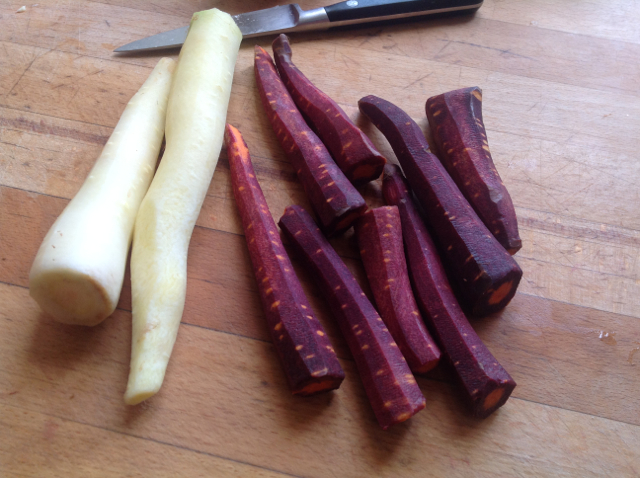
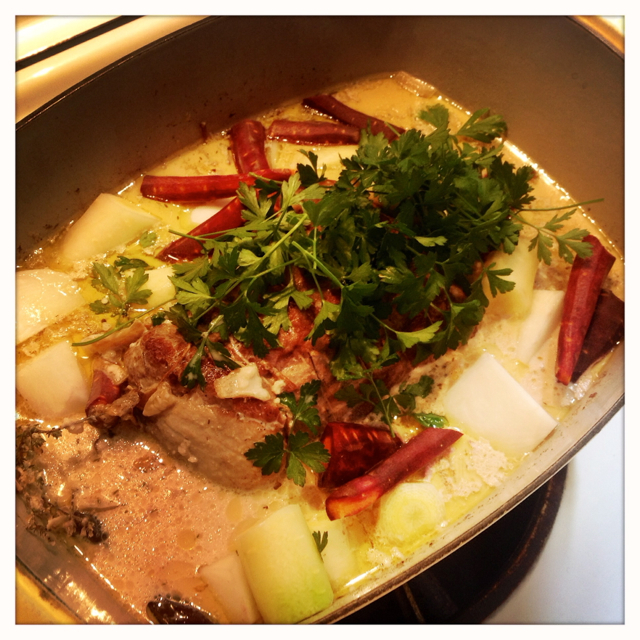
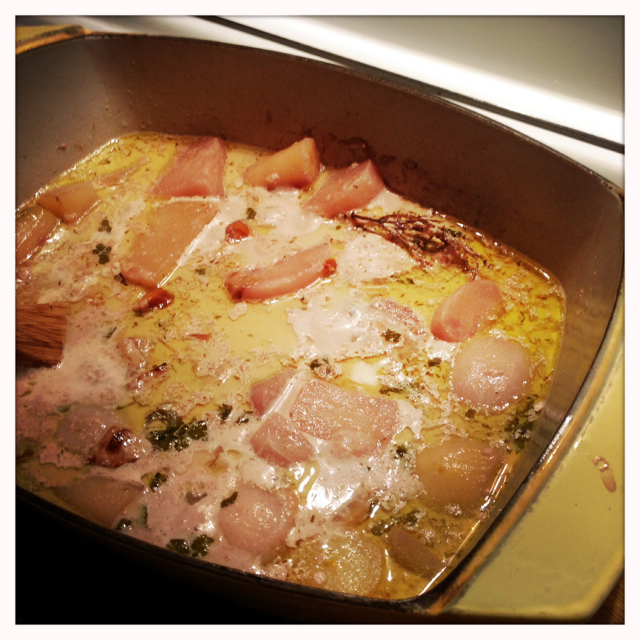
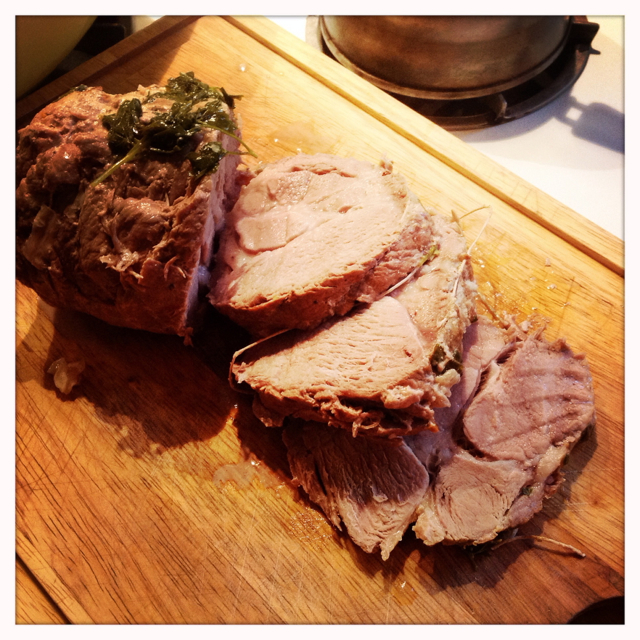
the empties: the Boulevard Napoleon Grenache Gris white and a few reds…had to show you these beautifully coloured carrots – they actually gave the milk sauce an almost mauve tint by the endAfter the meat has been cooking for awhile in the milk, drop the vegies and parsley inamples of milk sauce……to serve with this incredibly juicy meat. The butcher told me the pork roll was ‘parsleyed’ (‘persille’) – I thought he meant stuffed with parsley, but he laughed and corrected me – it actually refers the lines of fat running through the piece , ‘marbled’ as we might say. Even the Vigneron hadn’t heard of this term, so I was proud to bestow some francais on him.
1.5kg roll of roasting pork – preferably of shoulder (fillet is drier and less fat, don’t want that)
1 litre full cream milk
2 large onions, sliced
6 carrots, cut into in large chunks
8 potatoes, as above
8 small turnips, as above
4-5 cloves of garlic
2 sprigs fresh thyme
bunch fresh sage (about 10-12 leaves)
2 sprigs rosemary
oil, butter
salt, pepper
method:
Fry up the onions in heavy cast iron pot with a big chunk of butter (30-40g) and a little olive oil, until golden.
Add the roll of pork and brown on each side over medium -high heat.
When the meat is almost all browned, add the garlic and salt, pepper to taste. I find garlic burns very easily, so I add it near the end of the browning.
Pour over the milk (meat should be 3/4 covered, if not add more ) and add the herbs.
Cover with lid and let simmer for an hour.
Add the carrots and turnips and keep simmering for another hour.
Add potatoes and keep simmering until they are tender.
Serve with lashings of dijon mustard on the side and a big white or red wine!
N.B. If this is prepared the night before eating, I don’t add any of the vegetables until the next day.
And. I cook this for a few hours, the longer the better. I like it when the meat falls apart. A lot of recipes cook it for less though, and you keep the form of the pork roll and then slice it. As the French would say, ‘as you want’…
A big Hip hip to this New Year, 2013! May it be a good one for all and a happy and healthy one.
Just thought I’d say I haven’t forgotten about the blog, just busy cruising the streets in S.A. (South Australia) and lapping up as much quality time as possible, before the annually dreaded departure. Gotta make the most of it!
But somehow there’s those petite ‘mon Dieu’ surprises that always bring France back to mind…
les geants… as seen at the Adelaide Central Market
I must admit I often feel flat at this time of year, well for the first few weeks anyway – no more bare legs and t-shirts, no more swimming outdoors, cold dashes out of the shower… But finally I somehow get into the swing of it and embrace the warm fires inside, the hearty meals and walks in the brisk air. And after so many years of braving the cold INDOORS when I rented in Australia, I am loving and embracing the central heating everywhere.
I must admit I took this shot a while back, but I still love itPlane trees along the Canal du Midi
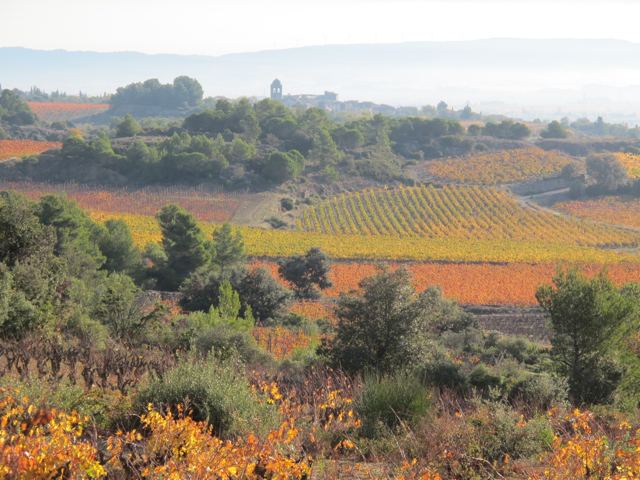
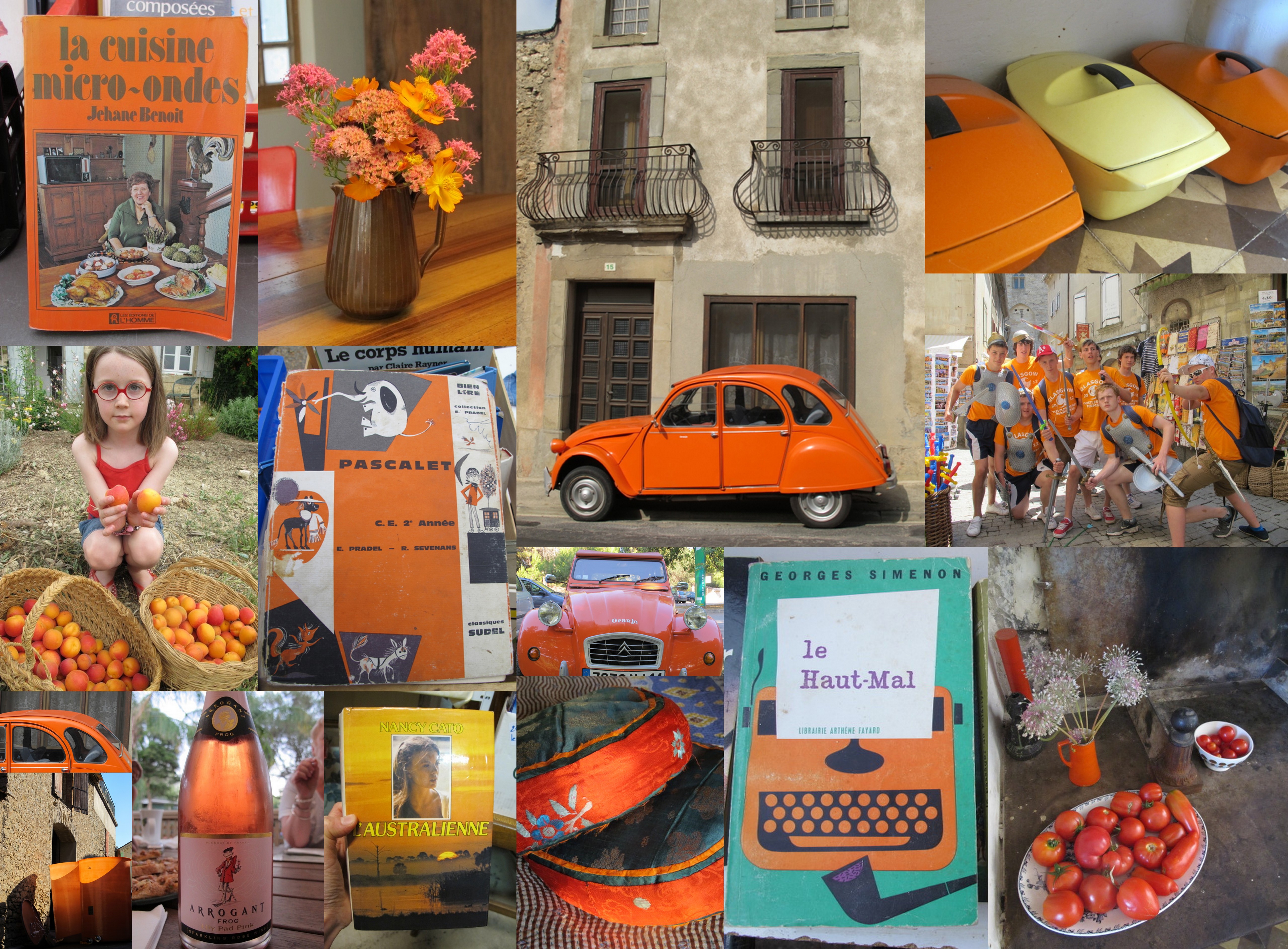
Yes, Autumn has arrived but thankfully with all its magical colour. It’s making me think ORANGE!
kids marvelling at the famous ‘Baked Bean’ parked on a village street …the lady owner steps in, la proprietaire de la voiture, …Rrrowrrrr!
I’m loving this colour right now and thought I’d put together a few of my favourite ‘orange’ pictures… And f you’ve wandered around this blog already, you might have picked up on the fact that I do have a little thing for collages. I’m pathetic, once I like something, I can’t stop! (my lovely girlfriends had diagnosed me at the age of 14 with O.C.D).
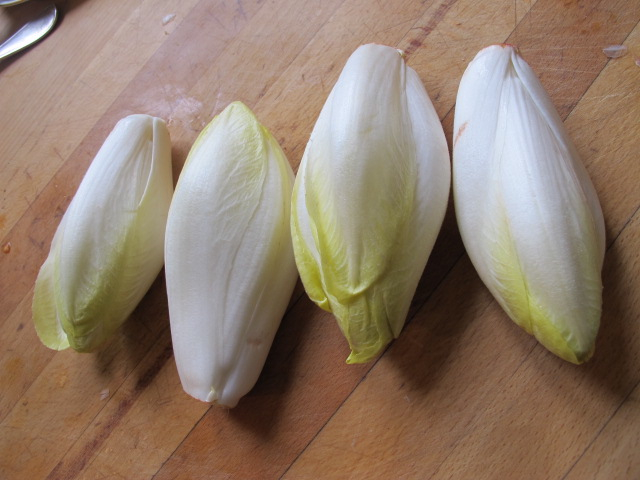
Witlof, Chicory, Endive… also known as the ‘Pearl of the North’ in France
‘Witlof’, ‘Chicory’, ‘Chicon’, ‘Endive’, ‘Belgian Endive’… I’m never quite sure what to call this vegetable. Each country seems to have a different name for it. In Australia for example, we call it ‘witlof’? Here in France it is called ‘endive’ and would you believe it has been grown commercially since only the 1930’s.
Whatever the name for it, since moving to France I have developed a huge liking for this interesting vegetable from the Chicory family. Thanks to Benji and his mum, I was introduced to a beautiful new ingredient and a few recipes that are now family favourites. Even our six-year-old loves eating them.
Endives are so verstile – they make a great salad when served raw with vinaigrette drizzled over it or, the particular family favourite, when braised with white wine and lardons and parsley, over a gentle heat for a few hours (the longer the better, you want them to caramelise!). You can serve this dish on its own or it makes a great side dish to lamb chops, veal or pork.
During the first few weeks of us living back in Australia in 2004, I decided to prepare the family favourite for our friends who we were lodging with. I was so excited to share this newly-loved vegetable of mine. After quite a search, I finally found them in a fruit and veg shop in North Fitzroy. I filled the bag, enough for four people and when I went to pay I nearly fell over. They were so expensive! I concealed my shock and quietly paid the money, vowing never again to buy this vegie in this suburb again. I at last appreciated why Claude (my Frenchie – amazing cook – friend who was living in Western Australia with his NZ wife), when he had yearnings for a good old endive dish, would only use three or four of them in a gratin. Braising them en masse was a complete luxury. Anyway – big sigh of relief – the dish worked out pretty well that evening, but not to be repeated for quite some time!
Here in France however, they are cheap and we eat them regularly, especially around October. A few years ago, I had to prepare a lunch at the last minute for some friends of friends travelling through the area. I added pan-fried chicken thigh fillets and julienned carrots to a pot of left-over braised endives and the result was really delicious. One of our lunch guests, the owner of a well-known bakery in Melbourne (yeah, not much pressure), was keen to get the recipe. High five! I was tres contente. I’ve been adding the chicken and the carrots for many a meal since.
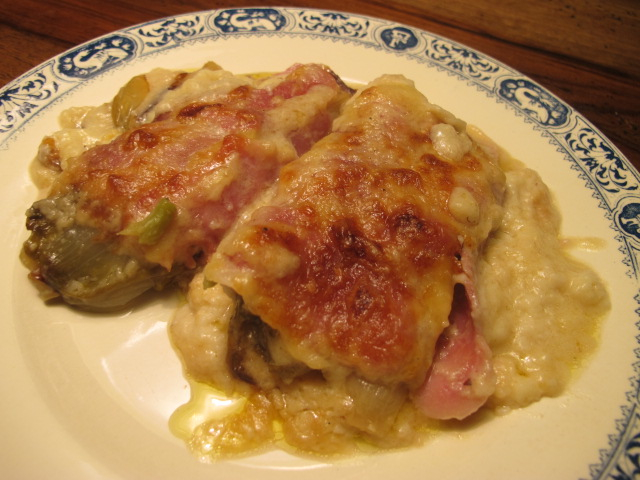
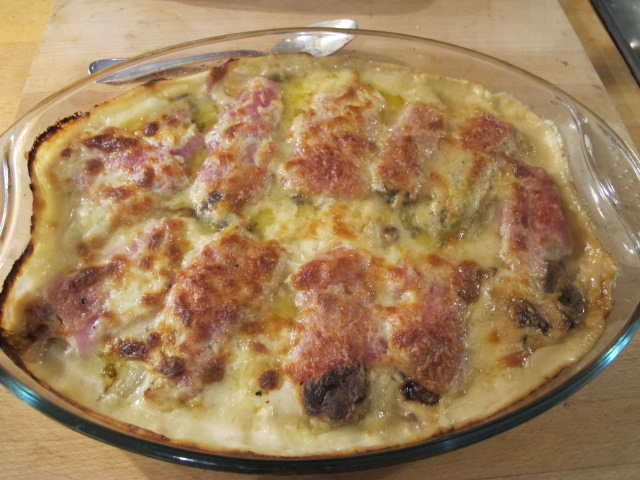
But much to my husband’s relief (I’m someone that could eat the same dish 4 times in the one week if I like it), I’ve branched out and tried a new recipe – the traditional ‘Gratin d’Endives au Jambon’ (Endives and Ham Gratin). Once again, as is usual for all the recipes I prepare, this is pretty simple and easy to make. It is a particularly good dish for the Autumn-Winter months and with today’s maximum temperature reaching six degrees celsius, I think I should get to it and make some.
Here’s the recipe for you… (I should tell Claude I’ve finally made it)
Gratin d’Endives au Jambon (serves 6)
Gratin d’Endives
ingredients:
(note: my quantities are always on the generous side – I prefer to have left-overs than not enough!)
8-10 endives (depending on size)
8 slices ham
60g butter
60g plain flour
200g Swiss Gruyere, grated (the AOC Gruyere ‘Alpage’ or ‘Reserve’ are incredible! – and even available in Australia)
1 litre full cream milk
salt, pepper
olive oil
method:
Trim stems off endives, pull off any discoloured leaves, then cut in half (I do this to help with cooking them through and browning)
Fry the endives in a pan over a low-medium heat with a little olive oil. As they begin to brown (or burn!), you can pour in a small amount of white wine to keep the pan moist. Fry until golden/dark golden and moisture has evaporated
(NB: some like to steam or boil the endives to part cook them but I prefer to fry them as I find there is too much liquid in the baking dish later when serving)
+ Heat oven to 180 degrees Celsius (about 7 or 8 on my gas oven) +
Fry the endives until golden
While the endives are cooking, prepare the cheese sauce (I like to grate the cheese before beginning the sauce so that your hands are free to keep stirring – and ready to be added when needed)
While the endives are cooking, prepare the cheese sauce
Melt butter in large saucepan
Heat milk in a different saucepan (it helps reduce overall cooking time if the milk is warm)
Stir in flour with a wooden spoon and cook for a few minutes over a gentle heat, stirring continuously.
Once it becomes a golden paste, pour in heated milk gradually, stirring continuously
(NB: How much milk you add depends on how thick or thin you like your sauce – my husband likes it thin and runny but I like it thickish and runny – so you may want to use less or more than the 1 litre. Just remember it will thicken over the heat eventually!)
add salt, pepper to taste
Once it comes to the boil, add the cheese and stir until melted.
Remove from heat.
Oil a large gratin/ baking dish
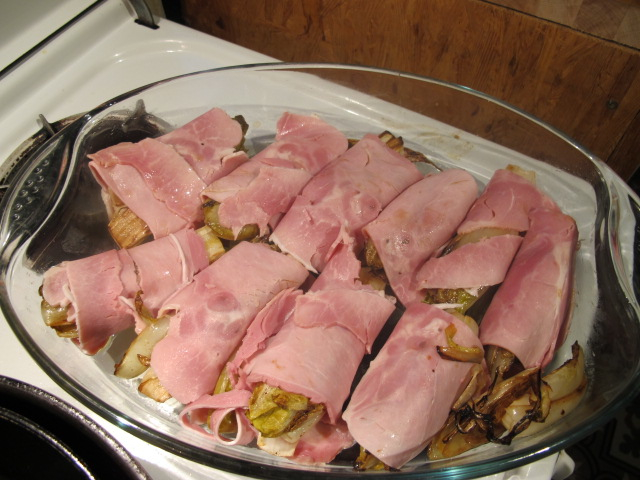
Gather your endive halves, wrapping two halves inside each slice of ham (as though it’s a whole endive)
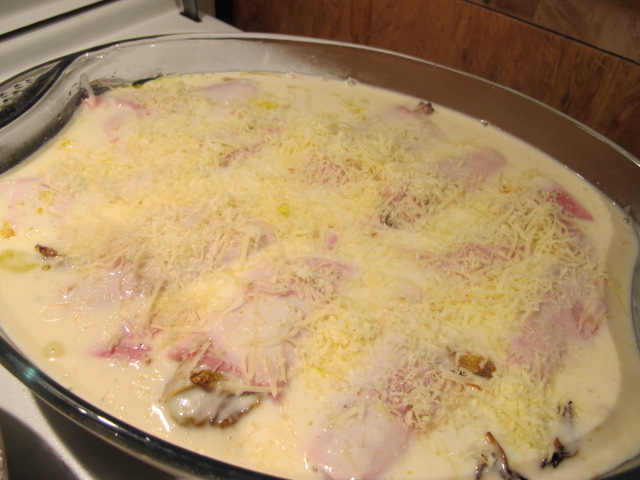
Place them in the baking dish and pour cheese sauce over the top – add a little extra grated Gruyere if desired
Place the wrapped endives in an oiled gratin/baking dish. (there’s 10 and not 8 in this one)Pour the cheese sauce over the endives and sprinkle with grated Gruyere










 The Vigneron's Wife